

Table of contents
- Overview
- Services previously provided free
- Treatment of seasonal items
- Electricity and gas tariffs
- Vehicle Excise Duty
- Air fares
- Communication charges
- Hedonic regression
- Chart collections
- Holiday prices
- Horse racing admission
- Live music events
- Overnight hotel accommodation
- Car insurance
- Home contents insurance
- Definitions
- Related links
- Cite this methodology article
1. Overview
As described in our Scope and coverage of consumer prices indices methodology article, our inflation measures are separated into components called "aggregates" (or sometimes "strata"). These exist within a hierarchy where "elementary aggregates" form the lowest level.
For most areas of the consumer prices basket, prices are collected through traditional sources, which include manually collecting a sample of prices in-store, online and by phone. Further information is available in our Traditional data aggregates in consumer prices methodology article. These are then combined with other elementary aggregates, using weights data, as described in our Higher-level aggregation and weights in consumer prices methodology article.
In this article, we describe special cases where data collection and calculation of elementary aggregate indices are not covered by these generic descriptions.
How we compile measures of inflation
This article is part of a set explaining how consumer price inflation and associated indices are compiled. Other related guidance articles include:
- Consumer price indices technical guidance
- Scope and coverage of consumer prices indices
- Traditional data aggregates in consumer prices
- Alternative data aggregates in consumer prices
- Private rents and owner-occupier housing aggregates in consumer prices
- Higher-level aggregation and weights in consumer prices
- Calculating the Household Costs Indices
- Calculating the Retail Price Index
- How we publish our consumer price outputs
This set of related articles replaces components of our Consumer Prices Indices Technical Manual, 2019
Back to table of contents2. Services previously provided free
Some services that were previously provided free at the point of provision have become chargeable. For example, the introduction of university fees in 1998 and the London congestion charge in 2003. This creates two problems when calculating indices:
there is no weight in the base period (expenditure is zero)
there is no base period price with which to compare the new price to create a price relative
The solution is to use a variation on the Laspeyres formula which uses quantities and price levels (rather than expenditure weights and price relatives). We treat the new product as if it were already included in an existing item index with zero price but with non-zero quantity equal to its consumption in the base period. The index is then adjusted from the point of introduction of the new price to take on the new expenditure. The adjustment is described in Formula 1.
Formula 1: How we adjust the Laspeyres index to account for a new free service
Where:
- Ia is the adjusted index
- Iu is the unadjusted index
- Expu is the average weekly household expenditure in the base period for the index
- Qf0 is the quantity of the newly priced service f used in the base period 0
- Pft is the price of the newly priced service f in current period t
In practice, it is not necessary to know Q0 and Pt explicitly, if their product (the expenditure at period t revalued with base year quantities) is known or can be estimated.
After the first year of introduction, the product may require a separate index.
University fees
From the 1998 to 1999 academic year, new students on full-time higher education courses contributed up to £1,000 a year towards the cost of their tuition. The actual amount depended on their own and, if appropriate, their parents' or spouse's income. The introduction of student fees raised several conceptual issues relating to the coverage of the indices and the service paid for.
Index coverage
The Consumer Prices Index including owner occupiers' housing costs (CPIH) and Consumer Prices Index (CPI) are intended to reflect the average spending pattern of private households and spending by residents of institutional households. However, in 1998 to 1999 the CPI covered only private households. The definition of household in the case of students might be considered to vary according to whether they are:
dependent or independent (depending on age and whether married)
living at home or away from home
living in communal or independent accommodation (if away from home)
However, most households would regard dependent students as part of their household, even if they were attending an institution away from home. It was therefore decided to treat all students in higher education as within scope.
Scale of fees
In the case of goods or services provided or partly paid for by the government, the amount paid is the charge made at the point of acquisition, not the full economic cost of the service. A similar approach is used for medicines bought on prescription, where the fixed charge is taken rather than the cost of the medicine itself. In this situation, students were liable for an amount between zero and a maximum set by the government, depending on their own or family income. This implied that the price recorded, and the index weight, should be that actually paid by the consumers, for which average estimates were made by the Department for Education.
Timing
The assumption was made that all fees are billed at the beginning of the academic year, before the October collection.
Method of incorporation
Initially, the index was combined with private education fees to compute an adjusted index.
The price of student fees was zero in the base period (January 1998) and an average of £550 in October 1998. This figure was combined with the estimated average payment of school fees. From 2000, higher education fees and private education fees were represented by separate item indices and no longer had special treatment.
Back to table of contents3. Treatment of seasonal items
This section describes the approach for basket items with strongly seasonal consumption patterns, such as:
coats
electric heaters
barbecues
gardening seeds
Usually, indices are calculated by comparing prices for the same product across two months. For seasonal items, this is often not possible because of product unavailability during out-of-season months. Therefore, we do not collect prices in some months for seasonal items. This approach presents two main challenges.
The first challenge is producing item indices during out-of-season months. In this case, we impute the index using the month-on-month price movement of the parent Classification of Individual Consumption According to Purpose (COICOP) class.
For example, if we do not collect prices for men's coats between April and August, and the garments class index increases by 1% between April and May, the same 1% movement is applied to the men's coats index between these months. More details on imputation can be found in our Higher-level aggregation and weights in consumer prices methodology article.
The second challenge is lacking base prices for the entire sample of products for items where prices are not collected in January. In this case, we use the base price imputation method described in our Traditional data aggregates in consumer prices methodology article. However, we use the COICOP class level to impute in these cases.
For instance, if barbecue prices are only collected from April to October, January base prices are imputed using the January-to-April class index to adjust the April prices. From May to October, indices are calculated by comparing the observed current prices with the imputed January base prices.
Two additional, highly seasonal, areas of the basket are covered in Section 6: Air fares and Section 10: Holiday prices.
Back to table of contents4. Electricity and gas tariffs
Four item indices are produced to measure the price change of variable- and fixed-term gas and electricity tariffs. Each index contains tariffs defined by supplier, region, payment method and, for electricity, whether they are single-rate or Economy 7.
For each tariff, two components are collected. These are:
the unit rate, which is the cost per unit of energy used
the standing charge, which is the daily cost, regardless of usage
Formula 2 shows how we calculate an average monthly bill for a tariff, using a fixed average annual consumption alongside the unit rate and standing charge.
Formula 2: How we calculate an average tariff monthly bill
Where:
- bt is the monthly bill
- st is the daily standing charge for month t
- ut is the unit rate for month t
- c is the average annual consumption
Holding consumption constant ensures that changes in the monthly bill only reflect price movements. The tariff index is then calculated as the ratio of bills across months. Tariff indices are weighted together with expenditure figures to calculate supplier indices, which are in turn weighted together to give the item index.
Fixed tariffs allow consumers to fix their unit rates and standing charges for a defined period. Households that fix their tariffs in different months may pay different rates within the same billing month. Formula 3 shows how we reflect this by using a 12-month rolling average to calculate an average monthly bill for the tariff.
Formula 3: Calculating an average bill for fixed tariffs
Where:
- bx is the average bill calculated using the fixed tariff standing charges and unit rates applied in month x (as described in Formula 2)
This approach assumes that:
customers do not leave their contract early
each month, one in 12 customers move from an old contract and take up the main fixed tariff from that supplier in that region
We currently only capture fixed tariffs of around one year in duration that are paid by direct debit. These are the most common type of tariff according to data from The Office of Gas and Electricity Markets (Ofgem). We do not include tariffs with additional services, such as boiler repair.
Back to table of contents5. Vehicle Excise Duty
Vehicle Excise Duty (VED) rates typically change in April each year and are pre-announced in the annual Budget. For this reason, the VED price index is only updated once a year to reflect these changes. The VED rate to which a car is subject depends on several factors, including:
whether or not it is in its first tax year
when it was first registered
fuel type
its carbon emissions category
list price
The period for which VED is paid also affects price.
A separate index is calculated for new and pre-owned cars using weighted average rates. Volume data provided by the Department for Transport (DFT) are used for weights. The volume data show the number of cars on the road, split by what tax band and the payment scheme they fall into. The VED rates for new and pre-owned car indices are then weighted together using expenditure data, to create an overall VED price index. The expenditure data are calculated by multiplying the DFT volume data and rate prices collected in the January base period.
Back to table of contents6. Air fares
Destinations for air fares are selected based on expenditure data derived from the International Passenger Survey (IPS) and passenger traffic data from the Civil Aviation Authority (CAA).
Prices are collected online from airline websites, reflecting travel with one item of checked-in baggage. Airlines are chosen based on having a departure closest to a predetermined time on index day, on randomly selected routes.
Only scheduled flights are included, as they account for most independent travel. Chartered flights typically happen as part of a package holiday, included in the foreign holiday index.
Price change is measured at the point of consumption (the date of travel) rather than acquisition (when the ticket was bought). We therefore collect prices in advance of a month. Return flights are captured at different intervals, reflecting usual consumer behaviour.
We collect prices for three sub-indices:
domestic flights: one month in advance, return one week later
short-haul flights: one and three months in advance, return two weeks later
long-haul flights: one, three and six months in advance, return three weeks later
There is some flexibility with price collection to allow replacements to be made.
For each flight type, sub-indices are calculated by advance booking period. To calculate these, we compare current period prices to January base prices, with routes weighted by expenditure shares.
Short-haul indices are calculated by combining the one- and three-month sub-indices with a 50:50 weight. Long-haul indices combine the one-, three- and six-month indices with a 10:45:45 weight. IPS expenditure and CAA passenger traffic data are used to combine the three flight types into the overall air fares index.
The air fares index is included in our monthly Consumer prices release. The domestic, European and long-haul flights sub-indices and weights are released annually from March 2025 in the user requested data section of our website. For example, our Domestic, European and long-haul air fares consumer prices sub-indices: January 2017 to February 2025 dataset.
Back to table of contents7. Communication charges
Fixed-line telephone charges
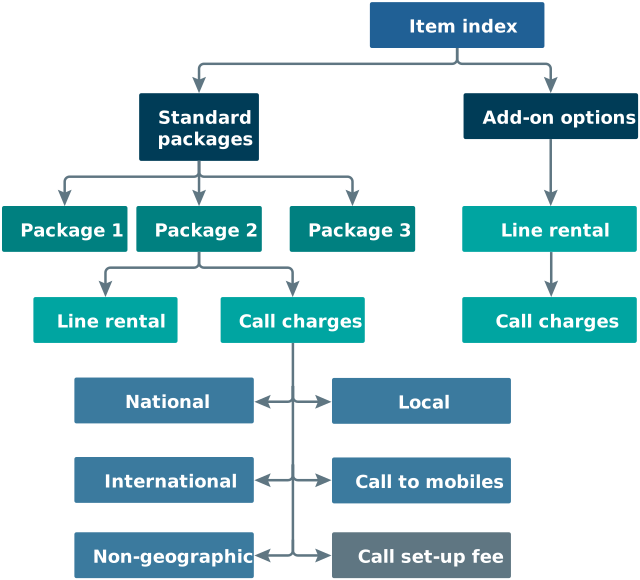
Figure 1 illustrates the detailed pricing information, including VAT, that is collected for both call charges and line rental for each of the main packages offered.
Within each of these packages, headline pence-per-minute call charges are collected for the following destinations:
local
national
international
calls to mobiles
non-geographical calls
Within each destination, they are collected for the following times of day:
daytime
evening
weekend
Call charges to 0870 and 0845 numbers are used to represent call charges to all non-geographic numbers. Line rental is collected for all packages.
Figure 1: Stratification of the fixed-line telephone charges index
Source: Special case aggregations in consumer prices from the Office for National Statistics
Download this image Figure 1: Stratification of the fixed-line telephone charges index
.svg (13.4 kB)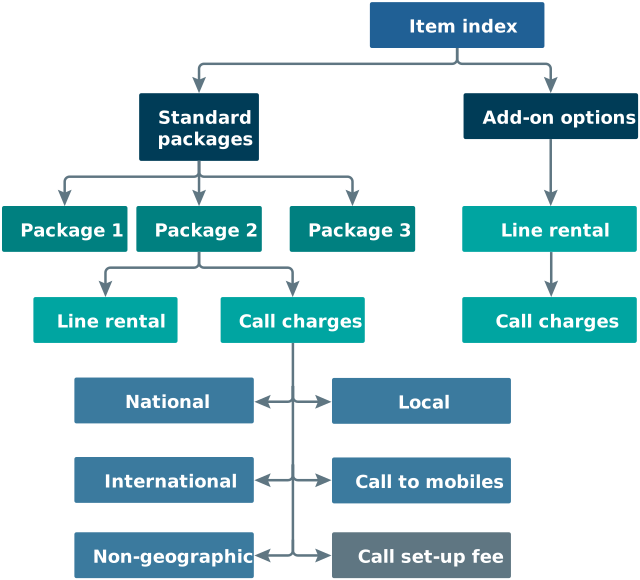
Detailed annual consumption information is obtained to weight together the individual components.
Cable telephones
For cable telephones, prices are obtained from major suppliers by:
type of call (local, national, international or to a mobile telephone)
time of day (daytime, evening and weekend)
type of connection fee
type of line rental
For each type of call, prices are weighted together by supplier and by destination (for international calls) or time of day (for other call types) to give indices for each call type. These are then weighted together to give an overall index for cable telephony.
Mobile phone charges
The large number of service providers, complex pricing structures and substantial variation in customer usage pose considerable difficulties in accurately measuring the average change in prices actually paid by customers for mobile phone services.
The index is based on the monthly bills for a set of detailed customer profiles supplied by the Office of Communications (Ofcom). Each month, the packages offered by the service providers are costed against these profiles and the cheapest package for each profile on each network is used in compiling the index. This methodology therefore uses a fixed basket of consumers, as opposed to a fixed basket of representative packages. Profiles are categorised according to voice, text and data usage. Company indices are further subdivided between pay-as-you-go (PAYG), contract customers and SIM-only customers, with some variation in specific methodology employed in each case. The final index is a weighted average of the company indices, with weights based on Ofcom expenditure data.
Pay-as-you-go
Pay-as-you-go (PAYG) users have no formal contract with a service provider and so are free to switch between the various packages available following price changes. Each month, the cheapest package available from each of the main service providers is selected for each customer profile and weighted over the profiles to produce a PAYG index for each supplier. The methodology only allows for in-year migration between packages within service providers. This is because substitution across providers typically involves the additional cost of replacement handsets, and price changes could also partly reflect changes in the quality of the service provided (because of differences in network coverage, for example).
Monthly contract
Monthly contract customers are usually "locked" into a package for 12 months or more, with a typical contract lasting 24 months. For profiles in this group, the cheapest package available is selected in January and tracked in subsequent months when compiling indices for each of the main providers. However, in each subsequent month, it is assumed that every 24th customer will switch to a cheaper alternative contract package (if one exists) from the same service provider, reflecting the ongoing turnover in existing contracts. The methodology accounts for the annual uplifts that are applied to existing customers.
SIM-only
SIM-only customers are typically "locked" into a contract for 12 months. The methodology used for these is the same as that for monthly contract customers. However, in each month, it is assumed that every 12th customer will switch to a cheaper alternative contract package.
Internet subscriptions and bundled telecommunication charges
These items are included in the communications division of the Consumer Prices Index (CPI) and the Consumer Prices Index including owner occupiers' housing costs (CPIH). Internet subscription charges include just the one type of communication, whereas bundles combine two or three types, including internet, phone and television use. Prices are collected centrally from the internet for a variety of packages and providers. The indices are constructed in the standard way by comparing prices in the current month with those in the previous January. Introductory deals are excluded on the basis that most people would be paying the standard contracted price.
Back to table of contents8. Hedonic regression
Our inflation measures are designed to capture the price change of a fixed basket of goods and services. Ideally, this means comparing prices for the same products in both the base and current months. However, products often leave the market, preventing some price matches. Our Traditional data aggregates in consumer prices methodology article describes approaches for handling replacements.
One approach described in this article is comparing the base price of an original product with the current price of a replacement product, using a direct quality adjustment to account for quality differences. For some items, we use hedonic regression methods to apply this quality adjustment. These items include:
laptops
personal computers (PCs)
tablets
smartwatches
smartphones
This method uses two samples: one for regular index compilation purposes, and another for estimating the regression model (which is periodically updated to reflect market changes).
The regression relates a product's price to its characteristics, such as processor speed or memory. It can be expressed in either a standard log-linear form (Formula 4) or a multiplicative form (Formula 5).
Formula 4: The regression formula used in hedonic regression
Formula 5: The multiplicative form of the regression model
Where:
pi is the predicted price
a is the intercept
b and c are coefficients
xi represents the product characteristics
Log prices are used for two reasons. Firstly, a multiplicative relationship between prices and characteristics better reflects pricing in the retail market, as the cost of adding a new feature is generally related to the underlying quality and price of a machine. Secondly, multiplicative relationships are less affected by general changes in price and so have a longer life span.
Models are developed iteratively, guided by statistical judgement and market research. This helps avoid issues from inter-correlated variables that could produce counter-intuitive models. For instance, "resolution" is partially based on "pixels per inch" and therefore we would avoid using both these variables in conjunction.
Hedonic models are used to estimate prices for both the original and replacement products. The ratio of these predicted prices is then used as a quality adjustment factor.
We illustrate the process with a worked example where a desktop collected in January leaves the market and is replaced by a desktop in February. The desktop is of similar quality and the only change is an increase in processor speed.
Step 1: Producing the regression function
We use a sample of personal computers (PCs) to fit a regression model, obtaining values for the coefficients described in Formula 4. These coefficients are shown in Table 1.
Step 2: Predict the old and new prices
| Regression model | January PC | February PC | |||
|---|---|---|---|---|---|
| Attribute | Coefficient | Level | Effect on price | Level | Effect on price |
| Brand | PC company A | PC company A | |||
| Intercept | 5.02277 | 1 | £151.83 | 1 | £151.83 |
| Monitor | 0.03886 | 19 | x 2.09 | 19 | x 2.09 |
| Processor speed | 0.00014 | 1600 | x 1.25 | 2800 | x 1.48 |
| Hard drive | 0.00004 | 640 | x 1.03 | 640 | x 1.03 |
| Memory (MB) | 0.00003 | 3072 | x 1.10 | 3072 | x 1.10 |
| Video card | 0.06673 | 1 | x 1.07 | 1 | x 1.07 |
| Predicted price | £480.87 | £569.35 | |||
| Actual price | £475.00 | £550.00 | |||
Download this table Table 1: Using the regression function to predict an old and new price
.xls .csvAs shown in Formula 5, the effect on price for each attribute is calculated by multiplying the level of the attribute by its coefficient and taking the exponential of the resulting value.
For instance, to calculate the effect of the monitor on price:
These effects on price are then multiplied together to give the overall predicted price:
For instance, to calculate the predicted price for the January PC:
Step 3: Adjust the base price to reflect new attributes
This step computes the price that the new product would have sold for, had it been available in the January (base) period. To do this we divide the predicted price for the new PC by the predicted price for the old. For example:
Then to calculate the new base price we multiply the base price for the old PC by the quality change ratio:
Step 4: Compare the current price with the new base price
The calculation shows that once the difference in quality between the original PC and its replacement has been accounted for, the price has effectively fallen by 2.2%. This compares with an increase of 15.8% in the unadjusted prices.
Back to table of contents9. Chart collections
We collect prices for some items based on a fixed basket of best-selling chart positions, rather than tracking individual product prices. This approach applies to the online purchase of:
computer games (including downloads)
CDs
DVDs
Blu-rays
The approach helps avoid a downward bias in the index caused by ageing products becoming cheaper, as the initial demand for the product falls. However, it can also produce more volatile indices because of the changing composition of the chart. To reduce volatility in some computer game indices, we collect prices twice a month - for both the index week and the following week.
We use a modified approach for chart collections for locally collected CDs, DVDs, Blu-rays, computer games and books of various types, including:
adult fiction
adult non-fiction
children's fiction
teenager's fiction
In these cases, we collect an initial sample of products, based on the highest-selling products in the chart. We then measure the change in price of the same product, regardless of its position in the chart, until it eventually leaves the chart and is replaced. Product characteristics such as charting position and page length are used to identify a similar replacement.
Back to table of contents10. Holiday prices
Foreign holidays
There are five principles in the construction of this index.
Principle 1
Holidays taken in different months are fundamentally different items, each with its own weight and price indicator. A January holiday is a different item from an August holiday.
Principle 2
Each month's index covers holidays for all 12 months of the year. The weight for holidays, like all weights, covers expenditure over a 12-month period.
This procedure means that price levels in any month are compared with those in the same month of the preceding year for the same holidays. The resulting price relative is weighted with the price relatives for previous months of the year to compile the index. The weight for an individual month's holidays reflects the relative expenditure for that month in a 12-month base period.
Principle 3
The price for a particular month's holiday changes only in the month in which the holiday is taken.
The index changes as and when people take holidays and to the extent that prices of holidays bought this year have changed from comparable holidays bought a year ago. In months when many people experience a price change, the index shows a larger overall change than in those months when few are affected. In the 11 months when the holiday is not taken, the price used in the calculation of the index is the last one to have been observed.
Principle 4
The price of a holiday is used when the holiday is taken, not when it is booked or when the final balance is paid.
For example, the price for a holiday to be taken in August 2026 first enters the index in August 2026 rather than in the earlier month when it was booked and any deposit was paid, or when the final balance was paid.
Principle 5
The price used is that paid by the customer, including any discounts. As described in our Scope and coverage of consumer prices indices methodology article, such discounts must be universally available.
Price collection
Prices are mostly taken from tour operators' websites for a sample of package holidays, both in winter and summer. However, some are taken from tour operators' brochures. Prices are collected from the internet at set times and depend on the specific holiday type. For example, hotel prices are collected six months in advance of departure. The prices used are the cost of a holiday for an adult sharing a double room.
These prices are compared with comparable holidays taken 12 months previously, and a price relative is calculated for each one. These are then combined, using information from the International Passenger Survey (IPS) on the composition of groups taking holidays, to give indices by country and month for each tour operator. The resulting indices are weighted together to give an index for each country in each month. These, in turn, are weighted together using data from the IPS on inclusive tours to individual countries abroad, to give the final index for the month.
Separate indices are calculated for:
self-catering holidays (for example in lodges, caravans, apartments and villas)
hotel breaks
cruises
city breaks
coach holidays
late-booked holidays
Prices for the three most heavily weighted items (hotels, self-catering holidays, and late booked holidays) are taken for departure in the main index price collection week in the middle of the month. This aligns the collection with the majority of the basket. City breaks are priced for departure at the beginning of the month. This was the traditional price collection point for most holidays up to 2023. Prices for cruises and coach holidays allow departure at any point during the month to maintain sample sizes for holidays where timetables and itineraries change each year.
UK holidays
The principles outlined in the Foreign holidays subsection earlier in Section 10: Holiday Prices also apply to UK holidays. To avoid double counting costs already covered in other sections, the index covers only independently booked accommodation and packages. Expenditure on packages may, however, include meals and leisure services to the extent that these components are included in the package. Five relatively homogenous types of holiday are sampled. These are:
weekend and short breaks (up to three nights)
hotel, and bed and breakfast accommodation
package holidays (such as holiday camps and centres)
coach holidays
self-catering holidays
A sample of holidays is distributed between these holiday types and between the regions of the UK.
Prices come principally from operators' websites or from enquiries to hotels, guest houses, or caravan and camping grounds. They are generally taken for seven-night stays but there are exceptions:
short-break holidays, where the length of visit is shorter
holiday camps, where the length of visit varies from three to seven nights
some types of self-catered accommodation, such as holiday cottages, lodges or caravan parks, where there is a flat rate irrespective of the number of guests
coach holidays, where a range of tour types are priced
These prices are weighted together using data on holiday types, location and the month in which they are taken, to provide a final index.
Back to table of contents11. Horse racing admission
From 2003, the cost of admission to race meetings has been included in consumer price statistics. Like holidays, race meetings for different months are seen as different items, with the programme of events changing from month to month and attendance patterns varying during the year. The basic principles outlined in the Foreign holidays subsection in Section 10: Holiday Prices therefore apply in a similar way to horse racing admissions.
Information on admission prices is collected for regular meetings at main racecourses as well as for special events. An average price for entry to the racecourses in the sample is calculated for each month and compared with the average price for the corresponding month in the previous year, for example, August 2026 is compared with August 2025. Each month's index covers admission for all 12 months of the year. For example, the price relative calculated for August is weighted with the price relatives for the previous months of the year to compile the item index.
Back to table of contents12. Live music events
Admission fees to live music events are measured by tracking prices at selected venues across the country, and not by following prices for a sample of bands. The sample is stratified by major venues, minor venues and festivals. Major venues are generally the arenas that are seen around cities, while minor venues are smaller concert halls and pub events.
Each month, for major and minor venues, prices are collected for a representative act appearing at the venue. The specific act is chosen based on their similarity with acts previously appearing there. Back catalogue, style of music and popularity are factors in choosing an act. For example, price change between a major international star and a local band would not be used in calculating the index, nor would a change between an original and a tribute act.
Stadium concerts are not included in the index. Traditionally they have only happened during the summer months and even then, not regularly, though that is changing. There are also issues with dissimilarity between acts.
Festivals are included in the index since the timing of events is more regular between years and acts appearing are similar between years. The methodology used for this subcomponent is the same as that used for package holidays and horseracing.
Back to table of contents13. Overnight hotel accommodation
One of the most volatile series in the basket is overnight hotel accommodation. Before 2025, this comprised one item, which was for an overnight stay in a hotel on index day in the middle of the month. Prices were collected from the internet and by phone, on the day before the nominal stay, and were influenced by short-term demand. The index was also sometimes affected by a lack of availability of hotel rooms to price when the sampled hotels were fully booked.
To help resolve the issue, a second item was added in 2025. This item used the same collection methodology, however, collection was conducted six weeks in advance of the stay. The effect of this change was to reduce the weight of the traditional item and increase the number of price quotes used to measure overnight accommodation overall, so that short-term variability was reduced.
As a result of investigative work undertaken in 2025, further changes were introduced in 2026. The sample used for the six weeks in advance collection was doubled, with the extra quotes covering an alternative date for the overnight stay - the Thursday after index week. To help manage collection costs, the traditional item collected the day before the stay was removed from the basket.
This decision was based on the need to improve the overall sample size (because of the advance collection compared with the day-before collection) and reduce volatility. The second date of stay was sufficiently far from index day to avoid any event-specific volatility. In addition, the majority of bookings made the day before travel are made by businesses, not consumers.
Back to table of contents14. Car insurance
The car insurance price index is a combination of two separate indices, one for fully comprehensive insurance and the other for third party, fire and theft insurance. Each of these is split further into price indices for specific car insurance companies. Expenditure data is used to weight these indices together and to ensure that a representative sample of insurers is selected.
Each index is constructed from actual insurance price quotes provided by a third-party company, rather than actual transacted prices. The quotes cover new policies only and are collected from insurance company websites using web-scraping technology. The quotes are provided for a database of customer profiles. The sampled customers cover a range of ages, driving experience, regions and vehicles.
The database of profiles is rotated every three months, meaning a comparable insurance quote is only collected for three consecutive months. To create a consistent price index, a rolling imputation process is carried out to accommodate new price quotes entering the sample while those over three-months old drop out. The three-month life cycle of a price quote works as follows:
Month 1
The price is recorded but does not feed into the price index.
Month 2
A January base price for the new quote is created by adjusting the Month 1 price by the movement in the elementary aggregate up to the month when the new quote was collected. A price relative for that product is then created by comparing the Month 2 price with the imputed base price.
Month 3
A price relative is calculated by comparing the Month 3 price with the imputed base price.
The price relatives are combined using standard elementary aggregation, as described in our Traditional data aggregates in consumer prices methodology article.
Back to table of contents15. Home contents insurance
The home contents insurance index is aggregated using price indices for specific insurance companies. Expenditure data are used to weight these indices together and to ensure that a representative sample of insurers is selected using probability proportional to size (PPS). Each index is constructed from actual insurance price quotes provided by a third-party company. These quotes are returned for a database of customer profiles. The customers sampled cover homes with a range of different attributes, including:
regional location
the material used for the construction of their house or flat
the number of rooms
the number of occupants
The database of profiles is rotated every three months. In the same way as car insurance, a rolling process of imputation is carried out to accommodate new price quotes.
Back to table of contents16. Definitions
All-items index
An index that is constructed using price indices that represent every type of expenditure within the scope of the consumer price statistic. It is an average measure of the change in the prices of goods and services bought for the purpose of consumption in the UK.
Aggregates
Aggregates (or "strata") are classifications into which the raw data can be separated. The strata "region" and "shop type" within item are generally used for the Consumer Prices Index including owner occupiers' housing costs (CPIH), Consumer Prices Index (CPI), Retail Prices Index (RPI) and the Household Costs Indices (HCIs). The data within each stratum are combined, and the resulting indices for each of the strata are then combined using stratum weights.
Alternative data
These are larger, automatically collected data sources. We have introduced several alternative data sources into the calculation of our consumer price indices since the early 2020s.
Basket
A convenient way to understand the nature of consumer price inflation statistics is to envisage a very large shopping basket comprising all the different kinds of goods and services bought by a typical household. As the prices of individual items in this basket vary, the total cost of the basket will also vary - consumer price statistics measure the change from month to month in this total cost.
Base prices
Our index methods measure price change between two months: the base month and the current month. Base prices are the prices that are used to represent the price of a product in the base month. This representative price may be a single sampled price, or an average of many different prices.
Central items
About 150 items for which the prices are collected centrally, where the index calculation is carried out separately from the processing of the local collection data.
Consumption segment
A consumption segment is broader in scope than individual items but is still intended to be relatively homogenous, with respect to price change.
For example, the consumption segment "rice" includes various representative items, such as dry rice, microwaveable rice, and rice snacks (like rice cakes) from the traditional data collection. For alternative data sources, the consumption segment includes all rice products that have been sold.
In areas of the basket where we are not using alternative data, a consumption segment matches one of our representative items exactly.
Class
In the CPIH, the CPI and the HCIs, all categories of expenditure on which significant amounts of money are spent are arranged into 12 divisions, which are subdivided into groups and then into classes. Examples of classes are bread and cereals, water supply, and transport insurance.
Current price
Our index methods measure price change between two months: the base month and the current month. Current prices are the prices that are used to represent the price of a product in the current month. This representative price may be a single sampled price, or an average of many different prices.
Division
In the CPIH, CPI and HCIs, all categories of expenditure on which significant amounts of money are spent are arranged into 12 divisions, such as clothing and footwear, transport, and recreation and culture.
We publish price indices for each division.
Elementary aggregates
The set of indices calculated at the very first stage of aggregation.
Group
In the CPIH and CPI, all categories of expenditure on which significant amounts of money are spent are arranged into 12 divisions, which are subdivided into groups. Examples of groups are food, postal services and insurance.
In the Retail Prices Index (RPI), all categories of expenditure on which significant amounts of money are spent are arranged into 14 groups, such as food, housing and motoring costs.
We publish price indices for each CPIH/CPI and RPI group.
Index day
The specific Tuesday within index week when price collectors collect the majority of prices for traditional data sources. This maximises consistency in month‑to‑month comparisons.
Index week
The designated week, at or near the middle of each month, during which local price collectors gather prices. Index day falls within Index week.
Inflation rate
The percentage change of a price index between two points in time. We typically refer to the annual inflation rate (comparing the current month with the same month a year earlier), or the monthly inflation rate (comparing the current month with the previous month). This term is usually used to mean the all-items inflation rate.
Items
Any type of consumer good or service that can be purchased, for example, apples. Several different varieties of that item may be available, for example, Granny Smith and Braeburn apples.
Laspeyres Index
A base-weighted index, where the prices are combined using weights derived from data from the base period.
Laspeyres-type Index
A fixed base weight index, such as the CPIH, CPI, RPI, or HCIs that has the basic characteristics of a Laspeyres Index. It is the price of the basket at a given time, as a percentage of its price on the base date. The CPIH, CPI, RPI and HCIs are not true Laspeyres Indices, as the underlying quantities do not coincide with the base date, but is the most recent available 12 months.
Local collection items
Prices for items collected either in-store, online or by phone by price collectors in various locations across the country. These are supplemented by prices collected by head office staff for shops with national pricing policies, and regional services collection prices collected by phone, email or online for local services, such as plumbers, taxi hire and hotels.
Price quotes
Individual prices collected through traditional data collection for specific products or varieties that households buy.
Products
Products, or "varieties", are the varieties of goods or services available within an item specification. For example, automatic washing machines with different specifications are produced by different firms, but they are all automatic washing machines.
Representative items
Representative items are those items that are in the basket of goods and services.
Section
In the RPI, all categories of expenditure on which significant amounts of money are spent are arranged into 14 groups, which are then subdivided into about 85 sections. Examples of sections are bread, cigarettes, postage, footwear, and rail fares.
We publish price indices for each section.
Strata (stratum)
Strata (or "aggregates") are classifications into which the raw data can be separated. The strata "region" and "shop type" within item are generally used for the CPIH, CPI, RPI and HCIs. The data within each stratum are combined, and the resulting indices for each of the strata are then combined using stratum weights.
Traditional data
Prices that are manually collected through traditional sources (in-store, online and by phone). This applies to most areas of the consumer prices basket.
Weight
A factor by which a component is multiplied to reflect the level of consumers' expenditure on that component.
Back to table of contents18. Cite this methodology article
Office for National Statistics (ONS), published 25 March 2026, ONS website, methodology article Special case aggregations in consumer prices