

1. Overview
Census 2031 will be an important component of the current and future population and migration statistics system. It will be designed to provide high quality statistics that meet user needs in 2031, and to help meet needs for population statistics in future.
Census 2031 content must balance the need for comprehensive data with practical constraints, such as questionnaire length and respondent burden. This article outlines the evaluation criteria for deciding topic inclusion and content development for Census 2031. The criteria, which have been updated from Census 2021 through expert review, will allow evidence-based decisions, and support transparency and trust in the census process.
The evaluation criteria acknowledge the significance of the census for small populations. These criteria support the development of a modern, inclusive census for England and Wales that is trusted by the public and valued in decision-making to shape all our futures.
Back to table of contents2. Introduction to the evaluation criteria
The Office for National Statistics (ONS) invited views on our Census 2031: Consultation on content for England and Wales (PDF,1,334 KB) between 28 October 2025 and 4 February 2026. The primary purpose of the consultation was to provide evidence to support decisions about which topics should be included in Census 2031.
The focus was on information required from Census 2031, not the detailed questions that should be asked on the questionnaire. As preparations advance for Census 2031, the consultation process has a critical role in shaping its scope, ensuring it reflects both enduring and emerging user needs.
A consultation on the Government Statistical Service new Ethnicity Harmonised Standard (PDF, 747KB), to gather views on additional tick-box response options which may be required for the new ethnicity standard, ran at the same time as the topic consultation.
The evaluation of the Census 2031 topic consultation uses a similar approach to topic consultations that informed censuses in 2011 and 2021, with changes made after a thorough review to keep criteria relevant for Census 2031.
High-level categories for Census 2031 evaluation criteria
An overview of the high-level categories for Census 2031 evaluation criteria are:
User requirements
purpose
small geographies or populations
alternative sources (lack of)
multivariate analysis
comparability beyond England and Wales
continuity with previous censuses
Other considerations (impact on)
data quality
public acceptability
respondent burden
financial concerns
questionnaire mode
ability to optimise statistical integration
Operational requirements
maximising coverage or population base
coding of derived variables and adjustment for non-response
routing and validation
Each topic will be evaluated against each criterion listed:
user requirements criteria remain the most important criteria for evaluation
operational requirements criteria strengthen the case for inclusion of topics, especially if a topic is thought to improve coverage
other considerations criteria, together with the user requirements evidence, will help guide development of the census questionnaire and the continued development of admin-based statistics
A topic may not be included in Census 2031 despite a known need if issues are identified through content development, using the other considerations criteria. For example, a topic may not be included if we cannot develop a question that respondents can answer accurately.
The Census 2031 topic and content evaluation criteria were signed off in early January 2026 after consultation with the Methodological Assurance Review Panel (MARP) and engagement with a broad group of experts throughout 2025. This process was undertaken to gather feedback on proposed changes to the Census 2021 evaluation criteria. We also collaborated closely with the Northern Ireland Statistics and Research Agency (NISRA) and the National Records of Scotland (NRS) to ensure alignment of approaches where possible.
Back to table of contents3. Evaluation criteria for the census topics
Evidence collected from consultation responses and wider engagement, will be evaluated against the user requirements criteria to inform the selection of topics for inclusion in Census 2031. Wider evidence will be used to assess criteria relating to operational requirements and other considerations.
User requirements
The user requirements evaluation criteria are critical in assessing the need for information. They aim to ensure that topics included in Census 2031 are chosen because they have a strong benefit to society when collected through a census.
The user requirements criteria, with a brief description and relative weights, are described in the following 'evaluation criteria relating to user requirements' section. The criteria largely reflect those used in 2021 but have been adapted based on expert review and analysis, with changes made to descriptions and relative weights.
The main difference, compared with the criteria used in Census 2021, are changes to the relative weighting of these criteria. These modifications have been implemented following an analysis recommended by the Methodological Assurance Review Panel (MARP). The weighting for alternative data sources has been reduced compared with 2021, while the weighting for multivariate analysis has increased. This reflects lessons learned about the limitations of administrative data, and the value users place on the multivariate capabilities of the census.
Responses from users for each topic, including proposed new topics, will be assessed against these user requirements criteria. Each criterion directly links to specific questions in the consultation questionnaire. However, the Office for National Statistics (ONS) will not limit its analysis for specific criteria to these questions, if evidence is provided elsewhere in consultation responses where relevant. Wider ONS insight gathered from other engagement activities, including the 2023 consultation on the future of population and migration statistics, will also be considered.
The following section covers the six criteria in the user requirements criteria group.
Evaluation criteria relating to user requirements
Purpose
The purpose to which data will be used if collected is central to the evaluation process.
Purposes include, but are not restricted to: resource allocation, service planning, policy evaluation, equality assessment, and diversity monitoring.
The implications if the data are not collected, such as increased financial costs or reduced quality of data used in planning, are also important.
Requirements arising from legislation strengthen the case for inclusion.
The purpose criterion carries a relative weight of 30% within the overall user requirement criteria; this is the same relative weight used in the Census 2021 evaluation.
Small geographies or populations
The census provides the benefits of information for small population groups and at detailed geographic levels.
Information that is only required for broad geographic areas or large population groups may be better obtained from other statistical sources.
The small geographies or population criterion carries a relative weight of 25% within the overall user requirement criteria; this increased from a relative weight of 20% in Census 2021.
Alternative sources (lack of)
Information should only be collected through the census where user needs cannot be fully met by other sources (such as administrative data), including cases where quality requirements are not satisfied.
Considerations will be made as to whether suitable information is available from other sources.
The alternative sources criterion carries a relative weight of 5% within the overall user requirement criteria; this decreased from a relative weight of 15% in Census 2021.
Multivariate analysis
An important benefit of census data is the ability to analyse census variables against one another (multivariate analysis).
User requirements for multivariate analysis for a topic will strengthen the case for its inclusion in the census, if other sources cannot meet this need.
The multivariate analysis criterion carries a relative weight of 23% within the overall user requirement criteria; this increased from a relative weight of 15% in Census 2021.
Comparability beyond England and Wales
Data collected from the census are required on a coherent basis across a large geographical area.
If there is a user need, the three UK census offices will release harmonised census outputs that are coherent across the UK where possible; we will also consider needs for international comparability.
The comparability beyond England and Wales criterion carries a relative weight of 7% within the overall user requirement criteria; this decreased slightly since Census 2021, where the relative weight was 10%.
Continuity with previous censuses
Comparison with previous censuses is a benefit of census analysis and, wherever appropriate, the Census 2031 questionnaire will collect the same information as the Census 2021 questionnaire.
The continuity with previous censuses criterion carries a relative weight of 10% within the overall user requirement criteria; this is the same as the weight in 2021.
Other considerations
There are several things that need to be considered when designing Census 2031 content. Other considerations are factors which affect the feasibility and practicalities of implementing questions or topics, such as data quality, cost and respondent burden. These guide the development of census content (question and instructions) alongside user requirements.
Development needs for each topic will be assessed against these criteria, while recognising that each topic is likely to have individual needs in the development process. This approach will guide the development of individual questions and detailed content plans. Sometimes, despite strong user need, a topic may be excluded if it cannot be reliably or accurately measured.
Based on the expert review of these criteria, we have added a new criterion: "Ability to optimise statistical integration". This recognises the potential of administrative data to add value to Census 2031 outputs or support a future statistical system, through data linkage.
Each topic will be assessed as to how well it performed in 2021, using relevant evidence from Census 2021 where possible, supplemented by additional sources when data from 2021 are unavailable.
The following section covers the six criteria in the other considerations (impact on) criteria group.
Evaluation criteria relating to other considerations
Impact on data quality
The data collected in Census 2031 is intended to be of a quality suitable for producing outputs that meet the required user needs.
The information requested should be limited to details that respondents can readily provide or recall accurately.
Impact on public acceptability
The census should not ask sensitive or potentially intrusive questions that may have a negative effect on responses or may lead to respondents giving socially acceptable (rather than accurate answers); it should also not enquire about opinions or attitudes.
Additionally, the census is carried out for statistical purposes; it should not collect data that would deliberately promote commercial, political or sectarian groups or sponsor particular causes.
Impact on respondent burden
- The inclusion of questions on a topic should not impose an excessive burden on respondents, this may result from: lengthy instructions or explanations, complex routing, large numbers of response categories, or large numbers of questions on a single topic.
Impact on financial concerns
- Questions should not present major coding problems, require extensive processing, or significantly add to the overall cost of the census.
Impact on questionnaire mode
- The modes (methods) of the collection of data will be considered throughout the design of the questionnaire; the aim is that respondents interpret the questions and answer consistently across all modes, allowing consistent information to be collected.
Ability to optimise statistical integration
- The ability for Census 2031 content to increase the value of the census data through linkage, or to support the development of a future administrative data statistical system, will be considered in the development of census content.
The other considerations categorisation will help guide the development of the census questionnaire.
The Census 2031 other considerations criteria evaluation will move from the three-point scale used in Census 2021 to a five-point categorisation. This decision has been based on expert review to better reflect both positive and negative impacts of topics inclusion and their development.
Other considerations categorisation
High positive impact
- The inclusion of questions relating to this subtopic would have a high positive impact; for example, where the question improves the acceptability of census or other questions within Census 2031.
Medium positive impact
- The inclusion of questions relating to this subtopic would have a medium positive impact; for example, where the question improves clarity or supports respondent understanding, the impact on data quality would be positive.
No or minimal impact
- The inclusion of questions relating to this subtopic would have minimal or no measurable impact; for example, where the question is clear and familiar to respondents, the impact on all criteria would be minimal.
Medium negative impact
- The inclusion of questions relating to this subtopic would have a medium negative impact; for example, where questions may require minor clarification or additional time, this could moderately increase respondent burden.
High negative impact
- The inclusion of questions relating to this subtopic have been assessed to have a high negative impact; for example, a question asking for sensitive financial details without clear justification may be perceived as intrusive and potentially reduce response rates.
Operational requirements
We use some of the data collected during the census to support the delivery of the census or its outputs. For Census 2031, we will assess evidence for topics that were included in Census 2021 to determine whether any associated questions were used operationally and verify this with the ONS delivery teams. This framework is designed to support robust and effective census delivery.
Topics will be categorised as having maximum, moderate, or minimal importance in relation to operational requirements.
Maximising coverage is the most important operational consideration, because the main aim of the census is to provide a robust estimate of the usual resident population of England and Wales.
Evaluation criteria relating to operational requirements
Maximum
Where data collected on a topic are used to maximise coverage or to define a population base, they will be given high importance.
The Census 2031 questionnaire may include some questions that, for instance, support respondents in identifying who should be included in the questionnaire or are used to produce different output bases.
Moderate
It is expected that some outputs will be based on derived variables.
Topics may be included in the Census 2031 questionnaire if a user need is identified for data that are derived from a variable, even if there is no user need for outputs relating directly to the topic; for example, supervisory status has been required primarily for deriving the National Statistics Socio-economic Classification (NS-SEC) in past censuses.
Some core topics will be used to enable a better assessment and adjustment for the characteristics of non-responders.
Minimum
In an online census, respondents can be automatically routed around questions that they are not required to answer.
There will still be a paper version of the form, which is likely to need some routing questions.
Some questions are also used for validation, such as cross-checking between age and marital status.
The operational requirements and user requirements criteria support decisions on which topics should be included within Census 2031, as set out in Figure 1. This approach will be used to support the ONS's updated view on which topics will be included within Census 2031.
Once topics have been selected for further consideration, other considerations will primarily be used alongside the user requirement evidence to guide the development of the census questionnaire and the creation of administrative data research outputs. While each topic will be developed according to its specific needs, these other considerations help guide these developments.
Sometimes, even when a topic is assessed as "consider how to collect", it may still be excluded from Census 2031 if implementation is not feasible because of factors outlined under other considerations.
Figure 1: Combining the criteria to give an updated view on inclusion of topics Census 2031.

Download this image Figure 1: Combining the criteria to give an updated view on inclusion of topics Census 2031.
.png (29.1 kB)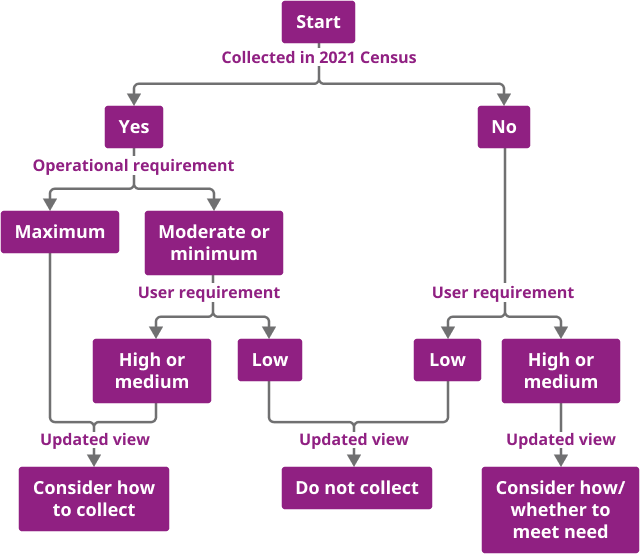
4. Our next steps
The Census 2031 topic consultation closed on 4 February 2026.
All responses are being moderated, using the moderation policy outlined in Annex B of the Topic Consultation (PDF, 1334KB), before being scored against the evaluation criteria set out in this article. Our scoring methodology will be benchmarked across topics, and we will engage with stakeholders to identify gaps and validate our understanding as needed. Final scores and moderated responses will be assured by a cross-ONS panel comprising methodological and census experts.
An overview of responses and next steps will be published in April 2026.
Comprehensive evaluation reports by topic will be released in late summer 2026. They will include our recommendations on which topics we will consider for Census 2031 inclusion and our plans for developing questions and content. These reports will set out explanations of how the evidence gathered during the consultation informed those decisions.
Back to table of contents6. Cite this article
Office for National Statistics (ONS), released 4 March 2026, ONS website, article, Census 2031: evaluation criteria for topics and content